

Prosthetics, including on implants
Prosthetics, including on implants
PROSTHETICS, INCLUDING ON IMPLANTS
Dental prosthetics is the branch of dentistry that rehabilitates masticatory, phonetic and aesthetic function by restoring missing or damaged teeth, using fixed (veneers, crowns, bridges) or removable (dentures) works. It restores the integrity of the dental arches, preventing functional disorders and improving the smile with the help of modern materials such as zirconium or ceramics. Edentulism creates significant discomfort. Missing even a single tooth can cause tooth displacement, malocclusion, and a number of other secondary conditions. To avoid such consequences, you should consult a prosthodontist.
Prosthetics prevent conditions such as periodontitis and bite deformities, improving the quality of life by restoring the ability to chew and speak. At the current stage, we distinguish several types of dental prosthetics: fixed prostheses - dental veneers (veneers), crowns and bridges (metal-ceramic, zirconium-ceramic, all-ceramic) fixed on teeth and implants, removable prostheses: mobile or partially mobile, total or partial prostheses.
1. Dental veneers
Bad habits, poor nutrition, poor quality drinking water and even stress – all of these can affect even the healthiest smile. The tooth enamel darkens or erodes, and streaks and dark spots may appear on the teeth. The solution is new dental prosthetics technology, such as dental veneers, which began to be used in the last century by Hollywood stars.
Veneers are very thin plates that are applied to the front wall of the teeth. Despite this, veneers do not yield in terms of strength to tooth enamel. They are made of ceramic, individually for each patient according to the size of the tooth, applied to the visible surface of the teeth to correct aesthetic imperfections, such as darkening, spaces, shape or wear, providing a more uniform and aesthetic smile, being an alternative to whitening or dental crowns.
The procedure is not painful and is the most successful method in recent years to restore a perfect smile. Dental veneers are used to solve a wide range of problems such as closing interdental spaces, enamel erosion. These problems are caused by acidic foods, imperfect amelogenesis, enamel hypoplasia or large unsightly fillings on the anterior teeth. There are 2 types of dental veneers: those made of porcelain or ceramic and those made of composite. Porcelain dental veneers are of higher quality than composite veneers. Porcelain being a translucent material, with increased strength and durability, restores a natural appearance to the teeth.
The objective of dental veneers is to provide the patient with restorations that perfectly integrate into their physiognomy. Dental aesthetics generally aims to reconstruct teeth as close to their natural shape as possible. Aesthetic needs are taken into account, to be in harmony with the gums, lips, and to preserve the vitality of the teeth for as long as possible. Treatment with dental veneers is usually applied in the following cases: tooth discolorations, which cannot be removed by in-office cleaning or with professional tooth whitening, the veneers will cover the stains on the teeth, and the final result will be a bright smile; superficially cracked or chipped teeth, which can no longer benefit from fillings that would perfectly solve the aesthetic problem; teeth with position changes, spaced or crowded, for which orthodontic treatment cannot be performed for certain reasons. Often, patients choose dental veneers because this procedure is faster and the expected effect is achieved immediately, while orthodontic treatment lasts on average 1-2 years, and dental veneers are done in a few days.
Advantages of treatment with dental veneers:
- corrects the shape, color, and position of teeth
- minimally invasive
- outstanding aesthetic results
- restoring self-confidence
2. Dental crowns
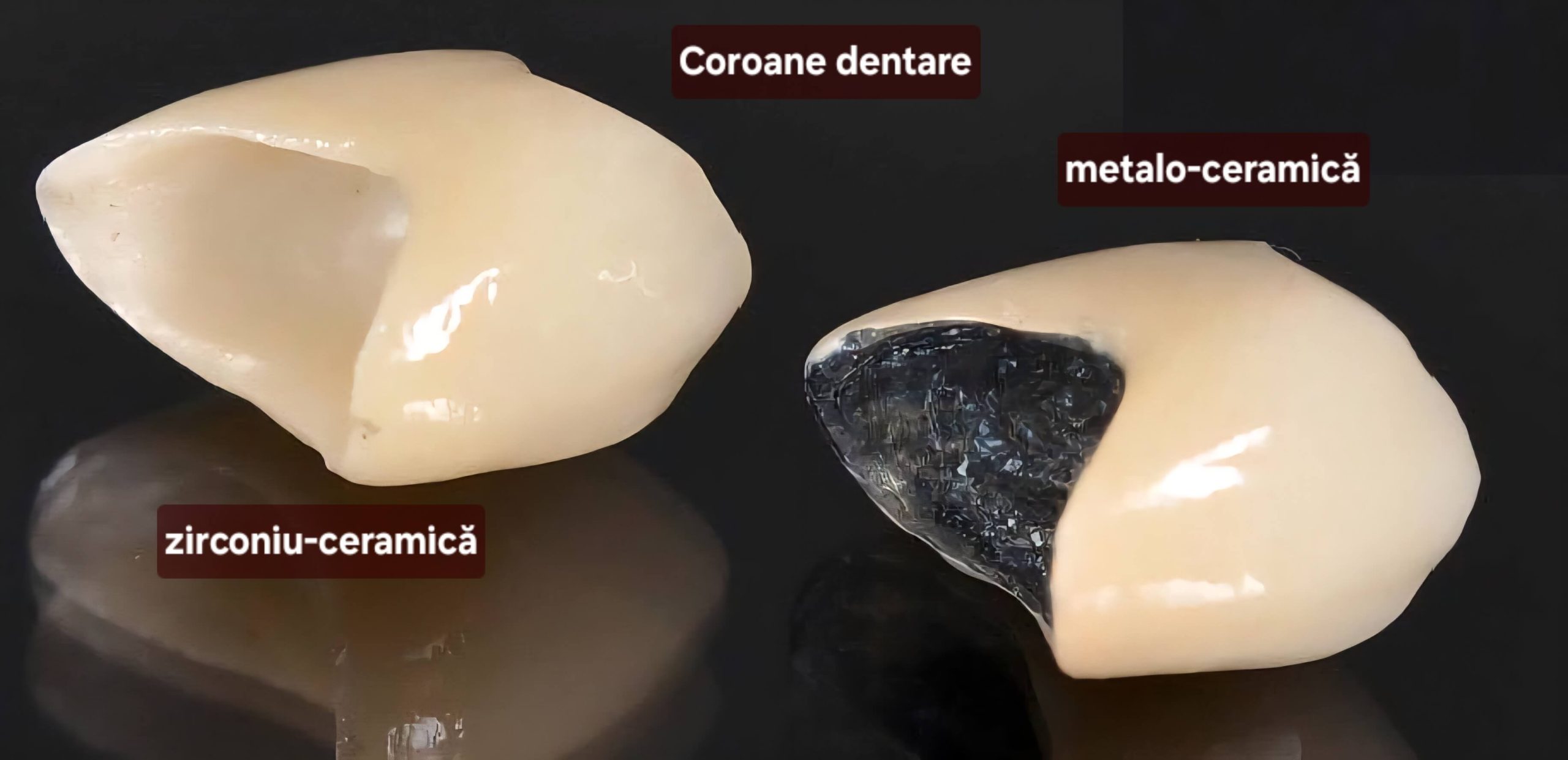
Dental crowns are orthopedic constructions that are applied to a damaged tooth to restore its shape, functionality and aesthetics. The crown protects the weakened tooth from destruction, decay and ensures full mastication. In modern dentistry, various materials are used: ceramic, metal-ceramic, zirconium-ceramic. Each option has specific characteristics, indications and limitations. The main purpose of a dental crown is to protect the natural tooth.
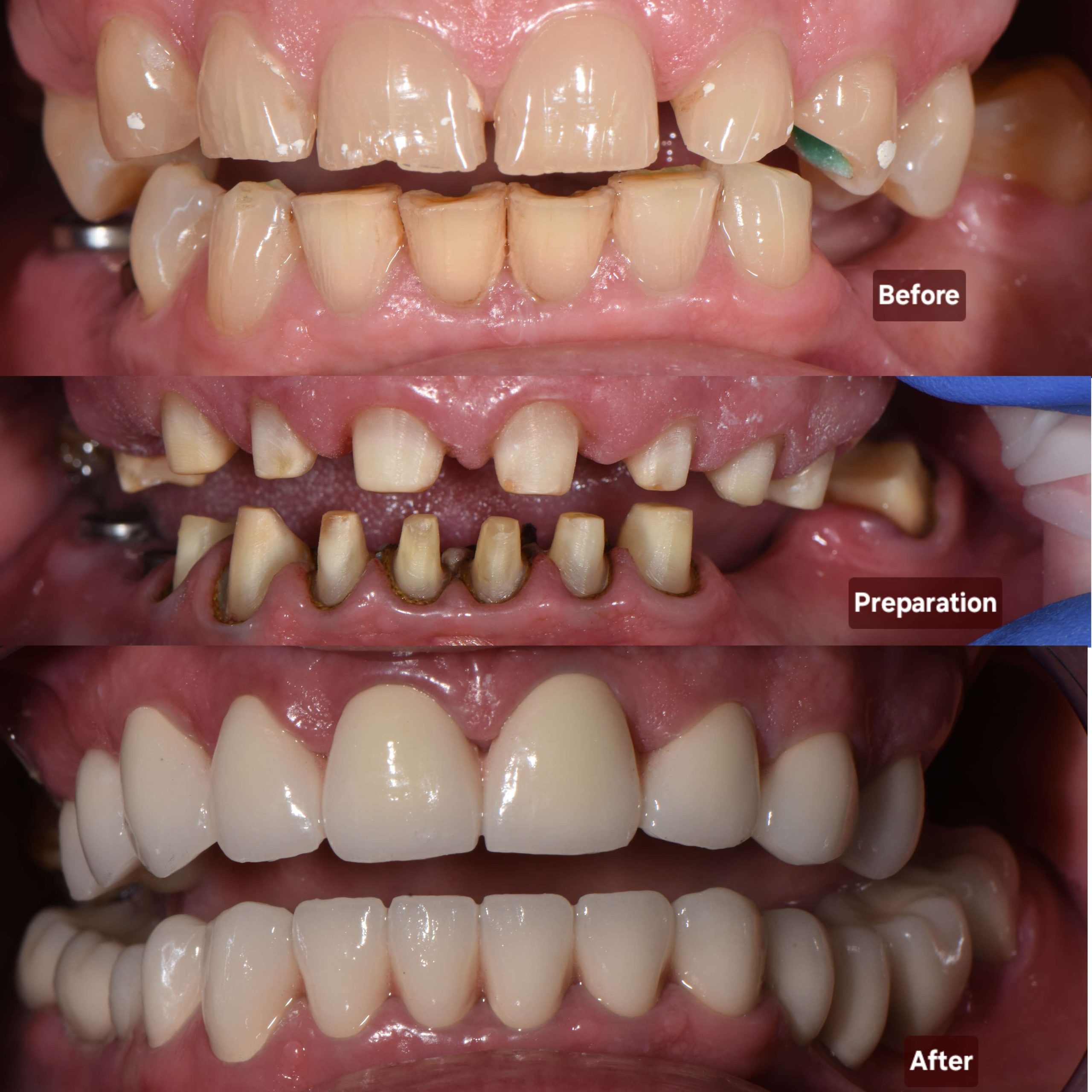
The installation of a crown is carried out in several stages. First, diagnostics and radiological investigations are carried out to determine the condition of the tooth and surrounding tissues. Then the doctor grinds the tooth and takes impressions or 3D scans. If necessary, until the final crown is made, a temporary crown can be applied to protect the tooth. After the trial and adjustment, the final crown is fixed with special cement, ensuring stability and longevity.
Modern materials allow for a perfect match in color and shape, making the crown almost indistinguishable from natural teeth. Thus, dental crowns are an essential part of modern prosthetic dentistry.
All-ceramic crowns are ceramic crowns that do not contain a metal or zirconium support. Their main advantage is high aesthetics: the crowns perfectly imitate the natural tooth and are ideal for the smile area. In addition, when installing them, minimal enamel is removed, which allows the vitality of the tooth to be preserved. There is a perception that ceramics are more fragile, but modern materials (for example, E-max pressed ceramics) withstand significant loads and are successfully used even on posterior teeth.
The qualities of ceramics are clearly superior to any other physiognomic material used in dentistry, being the only one that has such a special aesthetic, given the wide range of colors, the translucency close to that of natural teeth and the abrasion coefficient identical to that of natural enamel. Dental ceramics are not influenced by temperature variations.
Advantages of all-ceramic crowns:
- the most aesthetic prosthetic works, being made entirely of ceramic
- they do not have the strength of those with a metal or zirconium framework and, for this reason, can only be used in certain cases
- it is not recommended to make all-ceramic bridges that exceed 2 or 3 elements
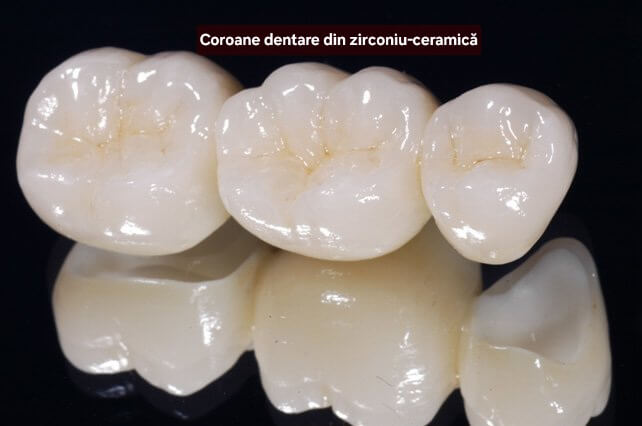
Zirconium-ceramic crowns crowns deserve special attention. This material combines the strength of metal with the aesthetics of ceramics. Zirconium crowns are biocompatible, do not cause allergic reactions and are durable. Thanks to digital modeling and milling on CAD/CAM equipment, these crowns are made with micron precision. They are ideal for both front teeth and molars, providing a balance between beauty and functionality.
Advantages of zirconium-ceramic crowns:
- does not cause allergic reactions
- combines strength with aesthetics
- balance between beauty and functionality
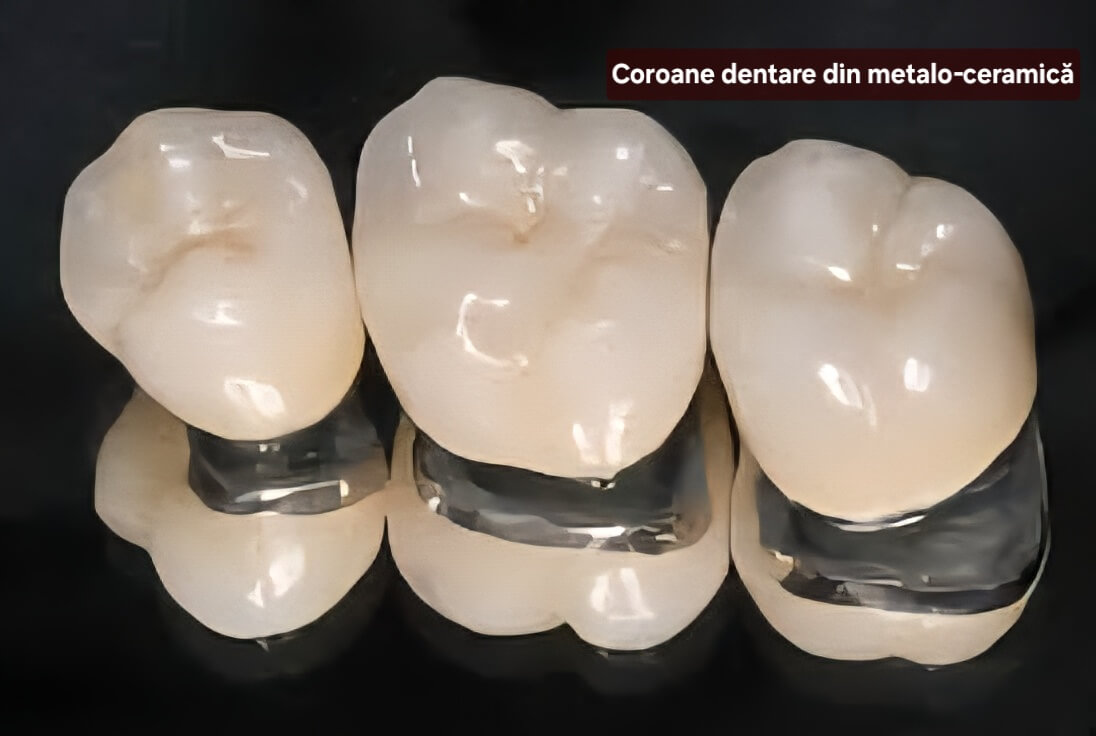
Metal-ceramic crowns sunt alcătuite dintr-un schelet metalic acoperit cu un strat ceramic. Această proteză combină rezistența metalului cu estetica ceramicii. Pentru instalare este necesară șlefuirea semnificativă a dintelui, deoarece trebuie luate în considerare ambele straturi de material. Totuși, metalo-ceramica a fost considerată mult timp „standardul de aur” în protezarea dentară, datorită caracteristicilor sale durabile și adaptabile.
Advantages of metal-ceramic crowns:
- high resistance to chewing forces
- satisfactory aesthetic appearance, being covered with a ceramic layer
- more affordable cost than zirconia or all-ceramic
- can also be used for extended dental bridges
Depending on each clinical case, temporary dental crownscan be made if necessary, they are composed of a metal skeleton covered with a layer of acrylic resin. Metal-acrylic dental crowns are used as an interim solution that precedes definitive prosthetics. This type of crown is usually used for: long-term temporary work, work on multiple teeth or implants (total bridge), in the case of implants inserted in the front to restore aesthetic function and provide comfort to the patient, or in the situation where the tooth has been treated following a severe condition and the evolution of the treatment must be monitored over time until a permanent dental crown is fixed.
3. Prosthetics on implant
In situations where the natural tooth cannot be saved and it is necessary to restore primarily the chewing function as well as the aesthetic one, to prevent the consequences of edentulism, a tandem procedure is used by reconstructing the tooth from 3 parts: the dental implant that takes the place of the tooth root, the prosthetic abutment (helps connect the implant to the crown) and the dental crown fixed to the implant (the upper part of the tooth that is visible in the oral cavity).
The prosthetic abutment for a dental implant is a connecting element, which at one end is attached to the implant, and at the other end serves as a support for the dental crown. Each implant manufacturer also produces abutments for its implants.
Often, in the case of implant prosthetics, zirconium-ceramic or metal-ceramic dental crowns are used, given the functional capabilities and durability offered by these two types of crowns. Depending on each clinical case, full-ceramic crowns can also be fixed (e.g. in the case of anterior teeth). (For more details, see the dental crowns section)
Depending on the method of fixing the dental crown to the implant, we distinguish between cemented and screw-retained prosthetics.
Cementation is a classic method, used for over 50 years. This involves applying a special dental cement, usually temporary, to "glue" the crown to the prosthetic abutment, previously screwed into the dental implant.
Screw-retained is a more modern method, introduced relatively recently, but which has quickly gained popularity. This method involves permanently “gluing” the crown to the prosthetic abutment in the laboratory, and then attaching it directly to the implant with a screw. Both methods have advantages and disadvantages, and the choice between them depends on several factors, including the specific clinical situation, patient preferences, and the experience of the dentist. The main benefit of screw-retained is that a screw-retained crown can be easily unscrewed for repairs, adjustments to shape or color, or other necessary modifications.
Advantages of implant prosthetics:
- restoring mastication function
- restoring the aesthetic appearance
- psychological comfort
- feeling close to natural teeth
4. Removable and partially removable dentures
Removable dentures are affordable solutions for replacing missing teeth, which rest on the gum and bone, can be removed for hygiene, are usually made of acrylic resins or nylon, and are fixed by clasps (metal or plastic hooks) that embrace the supporting teeth. They are ideal for patients with partial or total edentulism who cannot opt for dental implants for various reasons. It offers a rapid restoration of masticatory functionality and aesthetics, at an affordable price. These are of several types: complete dentures - replace all the teeth on a jaw, partial dentures - replace only a few missing teeth, anchoring themselves to the remaining natural ones, skeletal dentures - the more resistant and less bulky version, used when there are abutment teeth.
It is important to highlight that in the case of applying treatment through dentures, this solution requires adaptation, so you will make several visits to the dentist for checks and adjustments, the key to the durability of the denture lies in proper maintenance, it must be removed and sanitized daily, as a rule, dentures must be replaced approximately every 5 years, due to bone resorption, they may require adhesive creams for fixation, especially on the lower jaw, if the bone support is reduced.
Advantages of dentures:
- low costs
- effective solution in case of bone resorption
- restoring masticatory function
- improving the aesthetic appearance
Why choose us?
Choosing a dental clinic is an important decision. At MEDDENT, we combine solid medical experience with modern technology and a patient-centered approach to ensure every visit is safe, comfortable, and efficient.
Experience & professionalism
Highly experienced dentists dedicated to excellence and long-term oral health.
Personalized treatments
Solutions tailored to your needs, clearly explained and delivered with care.
Modern technology
Advanced equipment for precise, safe, and efficient treatments.
Friendly atmosphere
A comfortable environment for children, adults, and the whole family.
Frequently Asked Questions
Is dental treatment painful?
How often should I come for a dental check-up?
What should I do if I have a toothache?
Is dental anesthesia safe?
How long does a dental treatment take?
Book an Appointment

+373 22 210 407


Book an Appointment
+373 22 210 407
